The Complete Project Source Code Platform

Kashipara.com is a community of ONE million programmers and students, Just like you, Helping each other.Join them. It only takes a minute: Sign Up

Job Resume Template

ESP8266 NodeMCU PWM CONTROL – Dim LED (Analog Output) project in C/C++.

C/C++ project   Last updated on - June 3, 2021
Souvick Dhar
Souvick Dhar
C Embedded C Java PHP Python 
0 Reviews
0
1846 View
14 Downloads
 1846
 0
 14

In this page ESP8266 NodeMCU PWM CONTROL – Dim LED (Analog Output) project is a desktop application which is developed in C/C++ platform. This C/C++ project with tutorial and guide for developing a code. ESP8266 NodeMCU PWM CONTROL – Dim LED (Analog Output) is a open source you can Download zip and edit as per you need. If you want more latest C/C++ projects here. This is simple and basic level small project for learning purpose. Also you can modified this system as per your requriments and develop a perfect advance level project. This project can edit using a Arduino IDE IDE. Following C/C++ project contains all the important features which can be in use for the BE, BTech, MCA, BCA, Engineering, Bs.CS, IT, Software Engineering, Computer Science students and Devloper for their college projects. This script developed by Souvick Dhar. This desktop application 100% working smooth without any bug. It is developed using Embedded C and Database N/A. This software code helpful in academic projects and research paper for final year computer science. To download ESP8266 NodeMCU PWM CONTROL – Dim LED (Analog Output) project in C/C++ with source code files, please scroll down to the bottom of this page for the Download Zip file of source code button.

About project

project Name

ESP8266 NodeMCU PWM CONTROL – Dim LED (Analog Output)

Project Complexityadvanced
Duration15 Days
project ID5816
Developer NameSouvick Dhar
Publish DateJune 3, 2021
project PlatformC/C++
Programming LanguageFor this particular C/C++ project, Embedded C is required
Front EndC/C++
Back EndC, C++, MySQL
IDE ToolArduino IDE
Database IntegrationN/A
project Typedesktop Application
No of project Download14
project Total View1846
Today Trends484
Current Month Trends508
Last Month Trends22

You have any error or you don't understand project follow or any other problem.You can ask question. you know any answer or solution then give a answer and help other student.Complete they project perfectly.

Download ESP8266 NodeMCU PWM CONTROL – Dim LED (Analog Output) source code

Click the Download Button Below to Start Downloading

Download ESP8266 NodeMCU PWM CONTROL – Dim LED (Analog Output) source code at free of cost. Download link provide below.

Download Code
File size 0.0003 MB

Project Share and Earning Policy

Download ESP8266 NodeMCU PWM CONTROL – Dim LED (Analog Output) document

Download ESP8266 NodeMCU PWM CONTROL – Dim LED (Analog Output) Document PDF link below

Download PDF
File size 0 MB

Click Here For Project Document PDF Format.

Telegram channel

WhatsApp channel

Subscribe us on youtube

Features of the ESP8266 NodeMCU PWM CONTROL – Dim LED (Analog Output) project

We will implement the following feature in the C/C++ ESP8266 NodeMCU PWM CONTROL – Dim LED (Analog Output) Project:
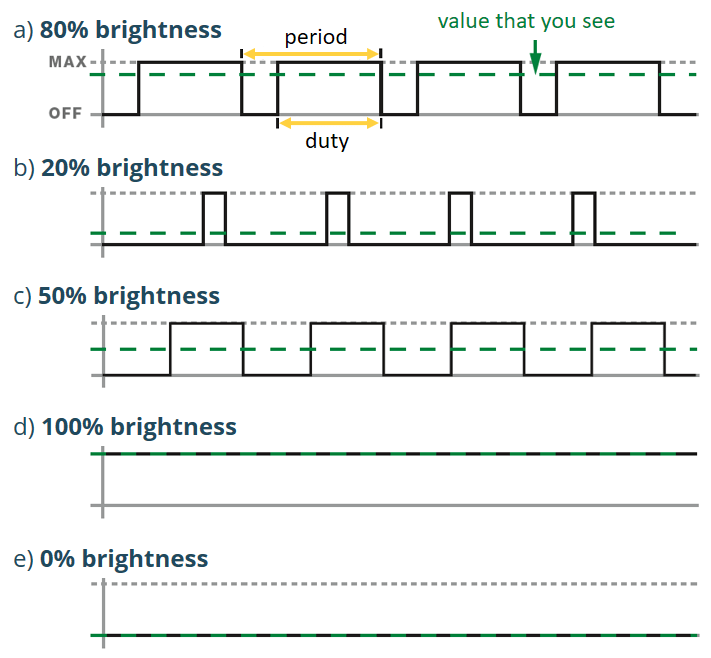
This project shows how to generate PWM signals with ESP8266 NodeMCU using Arduino IDE. As an example, we’ll dim the LED brightness by changing the duty cycle over time. The ESP8266 GPIOs can be set either to output 0V or 3.3V, but they can’t output any voltages in between. However, you can output “fake” mid-level voltages using pulse‑width modulation (PWM), which is how you’ll produce varying levels of LED brightness for this project. In this section, we’ll build a simple example that dims an LED so that you see how to use PWM in your projects. You’ll need the following parts: ESP8266 (read Best ESP8266 development boards) 5mm LED 330 Ohm resistor Breadboard Jumper wires Optional Oscilloscope (read Best Oscilloscopes for Beginners)

User modules and function of ESP8266 NodeMCU PWM CONTROL – Dim LED (Analog Output)

We will implement the following functionalities in the C/C++ ESP8266 NodeMCU PWM CONTROL – Dim LED (Analog Output) Project:

Software requirement to run this project

IDE : Atom, Code::Blocks, Visual Studio Code (VS Code), Dev C++, NetBeans, CodeLite, CLion, QtCreator, Xcode Compilers for C++ : GCC compiler on Windows

Hardware requirement to run this project

1. laptop/desktop. 2. minimum 1GB RAM. 3. minimum 100GB HDD.

How to install the project?

After you finish downloading the project, unzip the project file.

Copy the code to your Arduino IDE and upload it to your ESP8266.

In your Arduino IDE, go to Tools > Board and select your ESP8266 model (If you’re using an ESP-01, select “Generic ESP8266 Module”) .

Go to Tools > Port and select COM port the ESP8266 is connected to.

If you’re using an ESP-01, you need an FTDI programmer or Serial Adapter to upload code.

How to import database?

N/A

Why a download ESP8266 NodeMCU PWM CONTROL – Dim LED (Analog Output) project from kashipara?

Downloading the ESP8266 NodeMCU PWM CONTROL – Dim LED (Analog Output) project from Kashipara is a best choice for students, beginners, and developers looking for a reliable, well documented, and ready to use project in C/C++.

Top benifit to Download our project over other website:

  • Our ESP8266 NodeMCU PWM CONTROL – Dim LED (Analog Output) Source Code in C/C++ completly working. This project easy to understand and fully customizable as per your requriments.
  • Free Download our ESP8266 NodeMCU PWM CONTROL – Dim LED (Analog Output) projects.
  • Comprehensive Documentation:
    • We provide project Synopsis
    • ESP8266 NodeMCU PWM CONTROL – Dim LED (Analog Output) project Abstract in PDF and PPT formats download in reports.
    • Detailed Project Report
  • UML & Technical Diagrams Included:
  • This project Ideal for Academic Projects Perfect for B.E., B.Tech, MCA, BCA, BSc CS, and IT students
  • 100% Working Project – Tested and bug free.
  • Developed for Learning & Research – A strong foundation for building advanced ESP8266 NodeMCU PWM CONTROL – Dim LED (Analog Output) applications

How to create diagram?

Creating diagrams like Class Diagrams, Use Case Diagrams, Entity–Relationship (ER) Diagrams, Data Flow Diagrams (DFD), and Sequence Diagrams is essential for designing and understanding software systems. Here’s a proper guide to help you get started with each type:

ESP8266 NodeMCU PWM CONTROL – Dim LED (Analog Output) project output screen

output screen
output screen
output screen
output screen
output screen
output screen

Rate and Review

0
0
 0 Total Reviews

programmer reviews

What our programmer says about project

Explore more C/C++ projects